Inflation surge is possible – Dr. Mark Mobius

Much of the money (from QE from US Fed and other Central Banks) has remained on the commercial banks’ balance sheets, much to chagrin of the central bankers who wanted the banks to initiate lending so the economies would revive. Some of the money has also been diverted into the equity markets as well as property and other tangible assets such as commodities.

The low interest rates we see globally in many markets now disadvantage regular bank deposit savers and pensioners, while the equity holders have generally benefited as the surviving banks have grown bigger, and perhaps are now in the “too big to fail” territory. The savers who have suffered with low interest rates could be hit with another problem of high inflation down the road. Although inflation has generally remained low in the markets where central banks have been engaging in easing measures, many —including me— believe that once the banks gain the confidence to begin lending aggressively again, inflation will likely rise. This, of course is a double-edged sword. Countries battling deflationary forces, including Japan and the Eurozone — would welcome inflation. But the flip side is that inflation can quickly spiral out of control, and it can hit emerging market economies particularly hard, as a higher proportion of their consumers’ budgets go to basics like food and fuel.
– Dr. Mark Mobius, Executive Chairman, Templeton Emerging Markets Group

Please see this article for more details.
http://global.beyondbullsandbears.com/2014/11/20/implications-easing/

Dr. Mark Mobius earned Bachelors and Masters degrees from Boston University, and a Ph.D. in economics and political science from the Massachusetts Institute of Technology (MIT).
Nifty Valuation Check – 16Nov2014

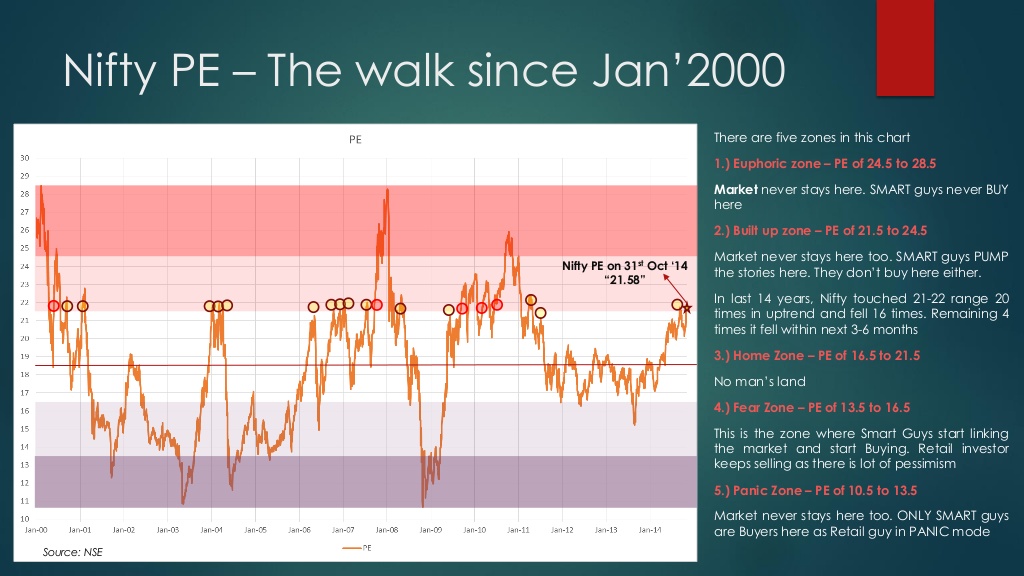
See the attached the Nifty P/E chart. This is the chart we should be trading with because the FIIs are looking at it.

Nifty has traded in a P/E range of 10.5 to 26.5 in the last 14 years from Jan 2000 to Oct 2014. About 95% of the time, Nifty has traded in P/E range of 12 to 24, with P/E 15-17 as ideal buying level, and P/E 21-23 as ideal selling level.

Risk-reward ratio for investors has been poor above P/E 21, but nimble traders can ride the Nifty long and exit/sell on downturn. Nifty is currently near P/E 22 at cmp 8383. There is trend line resistance on Nifty P/E chart around 23, so maybe 4-5% upside left till 8700, maybe not.

The following Nifty P/E Chart credit goes to Piyush Dwivedi.

NIFTY-long-term-PE-chart

nifty-pe-chart-analysis

Global Economic Review – 11 Oct 2014

  • World Bank cut its growth forecast for developing East Asia to 6.9% for 2014 and 2015 from 7.1% (forecasted in April).
  • US unemployment slipped to its 6-year low of 5.9% in September from 6.1% in August. Meanwhile, US non-farm payrolls increased by 248,000 in September, exceeding the market consensus of 210,000. As a result, the Dollar was close to its 4-year high.
  • The US Fed in its FOMC minutes (September 16-17) said that the current stance is appropriate amid concerns of global growth and the possibility of a stronger Dollar weighing on the US economy.
  • European Central Bank (ECB) maintained status quo with key policy rate unchanged at 0.05%. It unveiled the details of its purchases of asset-backed securities and covered bonds, scheduled to commence from mid-October.
  • Continue reading Global Economic Review – 11 Oct 2014