Category Archives: Banking

State Bank of India (SBI) – Stock Report

22 May 2015: India’s largest bank , SBI today reported 23% jump in standalone net profit at Rs 3,742 crore in the fourth quarter ended March 2015 with improvement in asset quality. SBI had net profit of Rs 3,040 crore during the same quarter a year ago. Total income of the bank also increased to Rs 48,616 crore in the last quarter of FY15, from Rs 42,443 crore in the same quarter a year ago.
Stock Rating: Buy at 265-285 for upside target of 315-335.

13 Feb 2015: India’s largest lender State Bank of India (SBI) posted a 30% rise in net profit, at Rs 2,910 crore, in the October-December quarter (Q3, FY15). The profit was driven by improvement in asset quality, higher non-interest income and stable corporate loan growth. Net interest income (NII) increase 9 per cent, while non-interest income jumped 24 per cent to Rs 5,238 crore on account of profit on sale of investments. Corporate loans grew 20% against muted growth recorded by other public sector banks. While retail loans rose 13 %, lending to the mid-corporate and small and medium sectors witnessed a marginal de-growth. Gross non-performing assets (NPAs) as a percentage of total advances improved to 4.90 % in Q3 FY15 from 5.73 % in the year-ago period. Sequentially, it remained almost flat (4.89 % in the previous quarter). The profit growth was lower due to higher provisioning for bad loans, which increased 26 %year-on-year (up 22.5 % sequentially) to Rs 5,235 crore.
“We have done a lot of hard work with individual follow-ups, account by account, to get resolution of bad assets. We have also strengthened our teams and now will do a mega auction of Rs 1,200-crore assets on March 14,” Arundhati Bhattacharya, Chairperson and Managing Director, SBI.
Stock Rating: Buy at 265-285 for upside target of 315-335.

Union Bank of India

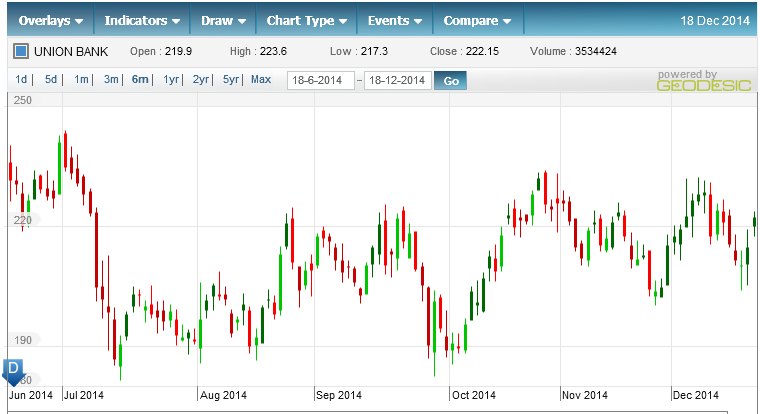
Union-Bank-of-India-logoDate, 17 Dec 2014: Union Bank of India (BSE 532477, NSE UNIONBANK) has shown remarkable strength over last few weeks, often becoming the first banking stock to go into green while the entire market is in red. Despite Nifty correction of 600 points (7%), Union Bank has held its levels and bounced back rapidly from all corrections. This is a very positive sign, and indicates that strong buying/ accumulation is happening from large investors, and we can see 240-250 level in the next rally. Investors in Indian stock market can buy Union Bank on all corrections and hold for at least 242 by Feb 2015, which will be about 13% gain on today’s close of Rs 215. Union Bank of India is among our top picks in the Indian stock market for the year 2015, with a reliable upside target of 273, which will give 26% gain from current level of 215. Therefore, investors can buy Union Bank at current level and all prices below 200 for good gains in year 2015.union-bank-chart-18dec2014

Inflation surge is possible – Dr. Mark Mobius

Much of the money (from QE from US Fed and other Central Banks) has remained on the commercial banks’ balance sheets, much to chagrin of the central bankers who wanted the banks to initiate lending so the economies would revive. Some of the money has also been diverted into the equity markets as well as property and other tangible assets such as commodities.

The low interest rates we see globally in many markets now disadvantage regular bank deposit savers and pensioners, while the equity holders have generally benefited as the surviving banks have grown bigger, and perhaps are now in the “too big to fail” territory. The savers who have suffered with low interest rates could be hit with another problem of high inflation down the road. Although inflation has generally remained low in the markets where central banks have been engaging in easing measures, many —including me— believe that once the banks gain the confidence to begin lending aggressively again, inflation will likely rise. This, of course is a double-edged sword. Countries battling deflationary forces, including Japan and the Eurozone — would welcome inflation. But the flip side is that inflation can quickly spiral out of control, and it can hit emerging market economies particularly hard, as a higher proportion of their consumers’ budgets go to basics like food and fuel.
– Dr. Mark Mobius, Executive Chairman, Templeton Emerging Markets Group

Please see this article for more details.
http://global.beyondbullsandbears.com/2014/11/20/implications-easing/

Dr. Mark Mobius earned Bachelors and Masters degrees from Boston University, and a Ph.D. in economics and political science from the Massachusetts Institute of Technology (MIT).